
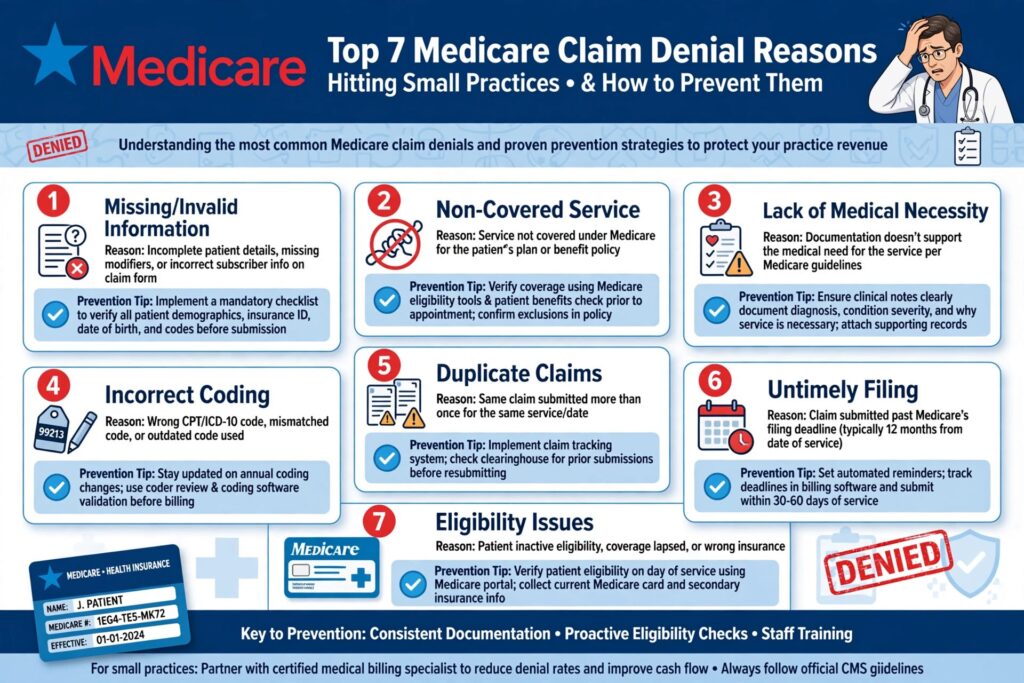
The Medicare claim denial reasons small practices run into most often are a short and repetitive list. Contractors publish the top causes every quarter, and the same handful keep appearing, which is useful news. A short list of recurring causes is a solvable problem rather than a general quality issue.
Before the list, one distinction decides where you go looking. A denial was processed by Medicare and declined, so it appears on your remittance. A rejection was returned unprocessable and never entered adjudication, so it appears in your acknowledgment file instead. Practices that review only remittances never see half of what is failing.
1. Exact Duplicate Claims
Duplicate submissions sit at the top of contractor denial reports, and almost none of them are intentional.
The cause is impatience with the processing window. Electronic claims generally take around two weeks to process, and staff who do not see a payment resubmit. The second claim is denied as a duplicate, and in volume the pattern starts to look like something worse than impatience.
The prevention is checking status before resubmitting. Contractor portals and interactive voice systems both show if a claim is still in process. Build a rule that no claim gets resubmitted until status has been checked, and give claims the full processing window before anyone touches them.
2. Bundled Services
The second recurring cause is billing a service that Medicare already pays for inside another procedure.
Medicare assigns status indicators to codes on the physician fee schedule, and certain codes are bundled by definition. Billing them alongside the parent procedure produces a denial every time, and in a practice doing the same procedure daily it produces the same denial daily until someone traces it.
Check the fee schedule status for codes for your practice bills together. Where a component is bundled, it does not get reported separately regardless of the work involved.
3. Hospice Enrollment
Claims for patients enrolled in hospice deny when the service relates to the terminal condition, and practices usually have no idea the patient enrolled.
This one is invisible without a check. The patient does not announce it, the referral does not mention it, and the denial arrives weeks later. Eligibility verification through the contractor portal shows hospice status, which is why verification needs to look at more than active coverage.
Where a service is unrelated to the terminal condition, it can be payable with the appropriate modifier. That determination belongs to the treating provider rather than the biller, and it needs to be made before submission rather than attached to an appeal afterward.
4. Services Treated as Routine or Preventive
A service coded in a way that reads as routine screening rather than treatment of an illness or injury denies as not being medically necessary.
The cause is usually the diagnosis rather than the procedure. A diagnosis that describes a general check rather than a condition under evaluation does not support medical necessity, even when the visit clearly addressed something.
Report the diagnosis that reflects the illness or injury being treated. Where the visit genuinely was preventive, the preventive code set and its own coverage rules apply instead.
5. Non-Covered Charges
Some services are excluded from Medicare by statute, and no documentation makes them payable.
These denials are preventable at the point of scheduling rather than billing. Confirm coverage before delivering a service you have not billed to Medicare before, and where a service is likely non-covered, issue the advance beneficiary notice before the service and have it signed.
Issuing that notice afterward does not preserve your ability to bill the patient. The timing is the requirement.
6. Missing or Invalid Rendering Provider
This one appears as a rejection rather than a denial, which is why practices often miss it entirely.
Claims returned for a missing performing provider, or for an individual identifier not properly associated with the billing group, never reach adjudication. Nothing appears on a remittance. The claim simply sits.
The cause is usually a configuration gap after a new provider joins, where the individual identifier was never linked to the group in the contractor’s system. Confirm that association when onboarding rather than discovering it through silence.
7. Patient Enrolled in a Medicare Advantage Plan
Claims submitted to Medicare for patients enrolled in a Medicare Advantage plan are returned, because the plan rather than the program is responsible.
Patients frequently miss the distinction and will say they have Medicare. The card is the clue, and eligibility verification is the confirmation. A check through the contractor portal shows the enrollment, and the claim goes to the plan instead.
This is the same verification step that catches hospice enrollment, which is part of why the check is worth building into intake rather than treating as optional.
The Pattern Behind the List
Five of these seven are caught by the same two habits.
Eligibility verification through the contractor portal before the visit catches hospice enrollment, Medicare Advantage enrollment, and coverage status. Status checking before resubmission catches duplicates. Neither takes long, and neither is a coding skill.
The remaining two, bundling and medical necessity coding, are reference problems. They respond to a current list of which codes your practice bills together, and to diagnosis selection that reflects what was treated.
Watch Rejections Separately From Denials
Three of the recurring causes on contractor reports are rejections rather than denials, and they never appear on a remittance.
Pull your acknowledgment file weekly and work it as its own queue. A practice that reviews remittances alone is seeing a partial picture of what is failing, and the missing part is the part with no paper trail arriving to prompt action.
Where to Start This Month
Pull your last ninety days of Medicare denials and rejections, group them by reason code, and compare the top five against this list.
Most practices find two causes producing the majority of the volume. Fixing those two is a smaller project than the denial report suggests, and it generally takes a process change rather than additional staff.
Repeat the exercise quarterly. Contractors publish updated top-error lists on roughly that cycle, and comparing your own pattern against theirs shows quickly if you are failing on something common or on something specific to your practice.
If Medicare denials are repeating and you want help identifying which step is producing each category, our team can review the pattern and trace them back.