
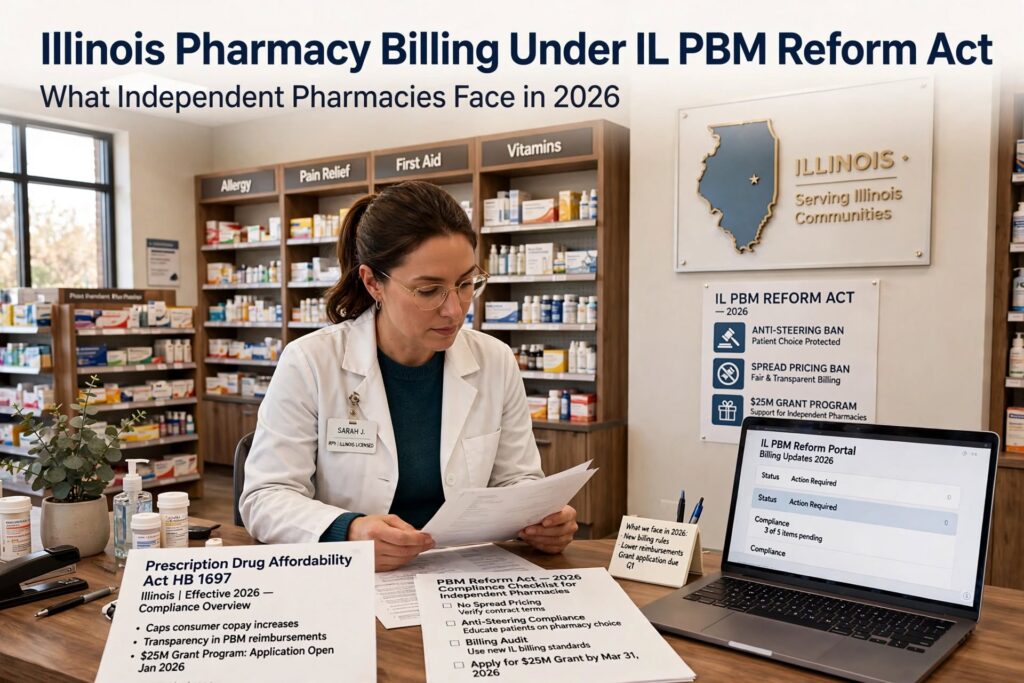
The pharmacy billing services Illinois independent stores rely on are operating under rules that changed at the start of this year. The state passed sweeping pharmacy benefit manager legislation in 2025, and most of its provisions took effect January 1, 2026.
The law most pharmacies know as Illinois PBM reform carries a different name on the books, and it is worth noting before you go looking for the text. It was enacted as House Bill 1697, carried as Public Act 104-0027, and titled the Prescription Drug Affordability Act. Searching for PBM reform will find commentary about it. Searching for the formal title will find the statute itself.
What the Law Actually Prohibits
The provisions that matter most to an independent pharmacy fall into three areas.
Spread Pricing Is Banned
Spread pricing is the practice of a PBM charging a health plan more for a drug than it reimburses the pharmacy and keeping the difference. The law prohibits it.
For a pharmacy, the value is indirect but real. Spread pricing gave PBMs a financial reason to reimburse pharmacies as little as possible, since the gap was revenue. Removing that mechanism removes one of the pressures that pushed reimbursement below cost.
Rebates Pass Through in Full
PBMs must pass one hundred percent of manufacturer rebates through to health plan sponsors or patients. This addresses a different piece of the same problem, which is revenue captured in the middle of the supply chain rather than reaching the plan paying for the drug or the patient taking it.
Steering Is Prohibited, With a Definition Worth Reading
The steering prohibition is the provision most directly aimed at protecting independent pharmacies, and its definition reaches further than most pharmacies expect.
Steering covers requiring or incentivizing a patient to use a specific pharmacy in which the PBM or an affiliate holds an ownership interest or control, including mail-order and specialty pharmacies. That much is expected.
The definition also covers a PBM reimbursing a pharmacy less than it reimburses itself or its own affiliated pharmacy for the same drug or the same pharmacist service. Differential reimbursement is treated as a form of steering rather than as a separate pricing matter.
That second element is the one an independent pharmacy can act on. If your reimbursement for a given drug sits below what the PBM’s affiliated pharmacy receives for the same fill, that is the conduct the statute addresses. Documenting the pattern is what makes a complaint possible.
Specialty Drug Classification Is Limited
PBMs have used specialty designations to route prescriptions away from community pharmacies, since a specialty classification often carries a network restriction that excludes independents.
The law limits misclassification of commonly used medications as specialty drugs. A specialty designation now has to rest on characteristics such as specialized handling by the dispensing pharmacy, administration by the dispensing pharmacy, or specialized clinical care including frequent dosing adjustments, intensive monitoring, or expanded patient support beyond ordinary dispensing.
Pharmacies losing volume to specialty routing should review which drugs are being classified that way and against which criteria. A common maintenance medication designated as specialty is worth questioning.
Funding Directed at Independent Pharmacies
The law creates funding streams aimed at pharmacy sustainability, and pharmacies serving rural, high-poverty, or underserved communities should be tracking them.
A per-member annual fee on PBMs funds support for independent pharmacies in underserved areas. A separate grant program was established to support independent pharmacies, administered through the state’s economic development agency. The law also streamlines the state’s access program for pharmacies serving rural and underserved communities, which is overseen by the agency that administers Medicaid.
Grant programs operate on application cycles rather than automatic distribution. A pharmacy that qualifies but never applies receives nothing, and the cycles are announced through agency channels rather than pushed to pharmacies individually.
Assign someone to watch for those announcements the way you would watch for a payer bulletin. The pharmacies that receive this funding are generally not the ones with the strongest case. They are the ones that had an application ready when the window opened.
Oversight Structure & What It Gives You
The law builds an oversight framework around PBMs that includes annual transparency reporting, plan audits, and market conduct examinations.
It also provides for reporting that may be used to produce an annual pharmacist dispensing cost report, including a survey of the average cost of dispensing a prescription in the state. That figure is the evidentiary foundation for any future argument about reimbursement adequacy, and pharmacies asked to contribute data should participate.
For day-to-day purposes, the oversight structure means underwater reimbursement and steering conduct now have a regulatory destination. A complaint has somewhere to go, which was less true before.
That only helps a pharmacy that can document what happened. Regulators act on records rather than on accounts of general unfairness, and the pharmacy that has tracked its own reimbursement against comparable fills is the one able to make a specific claim.
What Applies to Which Plans
Coverage of the law is broad but not universal, and pharmacies should not assume every claim falls under it.
The statute reaches services provided to both self-insured and insured plans, which is wider than many state PBM laws manage. Provisions affecting group health plans generally apply to policies or contracts issued, amended, delivered, or renewed on or after January 1, 2026, which means plans renewing later in the year come under the rules at renewal rather than on January 1.
The practical consequence is that a pharmacy may see different treatment across plans during 2026 depending on renewal timing. That is expected rather than a sign the law is being ignored.
Building This Into Your Operations
The law changes what PBMs may do. It does not automatically change what shows up on your remittances, and pharmacies that assume compliance without checking will not know when it is absent.
Track reimbursement by drug and by PBM so differential patterns are visible rather than suspected. Record instances where patients report being directed to a PBM-affiliated pharmacy, since steering shows up in patient experience before it shows up in your data. Review specialty classifications against the statutory criteria for the drugs you lose volume on. Watch for grant cycles rather than waiting for notification.
Keep the documentation organized enough that a complaint can be supported. Reimbursement records, communications directing patients elsewhere, and specialty designations applied to ordinary medications are the material that makes a case.
If reimbursement patterns look inconsistent across PBMs and you want a clearer view of where your fills are being paid below what comparable pharmacies receive, our team can review the claims data and lay out what it shows.