
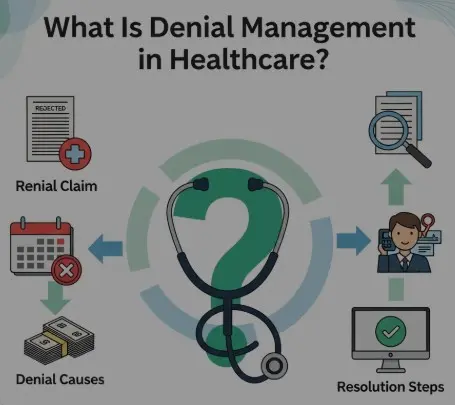
What Is Denial Management in Healthcare?
Imagine this: your healthcare practice submits hundreds of insurance claims each week, yet a significant percentage are denied. The rework, calls to insurance companies, and frustration on staff faces pile up, all while revenue that your practice relies on slips through the cracks. Denied claims cost healthcare providers millions of dollars every year, and without a structured approach, identifying the root causes and preventing future denials can feel like an endless uphill battle.
This is where denial management in healthcare comes into play. Denial management is not just about fixing individual claim errors it’s a systematic approach to analyzing patterns, improving billing processes, and ensuring claims are approved the first time. In this guide, we’ll explore what denial management really is, why it’s essential, and the strategies and tools you can implement to optimize your revenue cycle and reduce denials.
Understanding Denial Management
At its core, denial management in healthcare is the process of handling claims that are denied, suspended, pending, or even lost. Its ultimate goal is to recover lost revenue and prevent future denials. While many providers see denials as just administrative headaches, they are actually key indicators of inefficiencies in the billing and documentation processes.
A robust denial management system involves more than simply resubmitting a denied claim. It requires identifying the reason for the denial whether it’s incorrect coding, missing documentation, or an issue with patient eligibility then analyzing trends to uncover systemic problems. For example, if a particular payer frequently denies claims for missing prior authorizations, that signals a need to refine internal procedures.
By implementing a structured denial management approach, healthcare organizations can reduce revenue leakage, streamline operations, and maintain compliance with insurance and government regulations. Visualizing the process as a cycle identify, analyze, correct, prevent—helps staff understand their role in reducing denials and improving the overall revenue cycle.
Types of Claim Denials
Not all denials are the same. Understanding the different types is crucial to addressing them efficiently.
1. Hard Denials: These claims cannot be appealed. They usually result from errors such as services not covered under the patient’s insurance plan or missed filing deadlines.
2. Soft Denials: These claims can be corrected and resubmitted. Common examples include coding errors, incomplete documentation, or eligibility verification issues.
Top Causes of Denials:
| Cause | Example |
|---|---|
| Coding Errors | Using incorrect CPT or ICD-10 codes |
| Eligibility Issues | Patient not covered on the date of service |
| Missing Documentation | Incomplete medical records or signatures |
| Authorization Problems | Required pre-authorization not obtained |
The Denial Management Process
A structured denial management process ensures each denied claim is addressed efficiently while reducing future denials. Here’s a step-by-step approach:
Identifying the Problem: Each denied claim comes with a payer rejection code. Reviewing these codes helps pinpoint whether the issue is related to coding, documentation, or eligibility.
Analyzing Trends: One denied claim may seem minor, but patterns across multiple claims reveal recurring issues. For instance, if claims for a specific procedure are repeatedly denied, it signals a potential coding or policy problem.
Resolving Individual Claims: Correct the errors, update documentation, and resubmit the claim promptly. This step often involves coordination between the billing team, clinical staff, and the payer.
Preventing Future Denials: Implement workflow improvements, staff training, and policy changes. Proactive measures—like automated eligibility checks or pre-authorization alerts—can drastically reduce recurring denials.
Measuring Success: Track key performance indicators (KPIs) such as denial rate, first-pass claim acceptance, and days in accounts receivable. Regular reporting ensures the team knows whether interventions are effective.
Mini-Case Study: A mid-sized clinic implemented a denial management workflow that included automated pre-authorization alerts. Within three months, their denial rate dropped by 15%, resulting in a significant increase in monthly revenue.
Why Denial Management Matters
The importance of denial management extends beyond simply resolving denied claims:
Financial Impact: Each denied claim represents lost revenue. Efficient denial management helps recover these funds and prevents future losses. For example, healthcare organizations report spending hundreds of dollars in staff time per denied claim, making prevention far more cost-effective than correction.
Operational Efficiency: By streamlining billing workflows and reducing repetitive rework, staff can focus on patient care and other strategic tasks.
Compliance: Effective denial management ensures adherence to payer rules, government regulations, and CMS guidelines, reducing audit risk and potential penalties.
Incorporating denial management into the broader revenue cycle management (RCM) strategy leads to improved financial performance and a healthier bottom line.
Tools, Technology, and Best Practices
Leveraging technology can make denial management far more effective:
Denial Management Software: Platforms with AI-driven analytics help identify patterns and prioritize denials based on recoverable revenue. Dashboards provide real-time insights into trends.
Automation & Predictive Analytics: These tools predict potential claim denials before submission, allowing staff to correct errors proactively.
Staff Training & Workflow Optimization: Educate billing and coding teams on common denial reasons and the best corrective actions. Standardizing processes reduces human error and improves first-pass claim acceptance.
Regular Reporting: Track KPIs such as denial rate, time to resubmission, and revenue recovered. Use these insights to continuously refine processes.
Adopting these denial management strategies and denial prevention techniques ensures a smoother, more efficient revenue cycle and maximizes financial performance.
Common Mistakes and How to Avoid Them
Even experienced healthcare organizations make mistakes when managing denials. Avoid these pitfalls:
Ignoring trends in denied claims
Failing to appeal soft denials promptly
Relying solely on manual processes without leveraging technology
Not tracking KPIs or measuring denial management performance
By addressing these mistakes, practices can reduce denials, save staff time, and improve revenue recovery.
Conclusion
Effective denial management in healthcare is essential for financial health, operational efficiency, and regulatory compliance. By understanding the types of denials, implementing a structured process, leveraging technology, and continuously monitoring performance, healthcare organizations can recover lost revenue and prevent future claim denials.
Key takeaways:
Analyze and address both hard and soft denials.
Implement systematic workflows and staff training.
Use automation and predictive analytics for proactive prevention.
Track KPIs to measure and refine performance.
Take a close look at your current denial management practices. Could your practice recover more revenue with a structured workflow and the right technology? Don’t let denied claims slow your practice down. Discover how our denial management services can streamline your revenue cycle and recover lost revenue.