
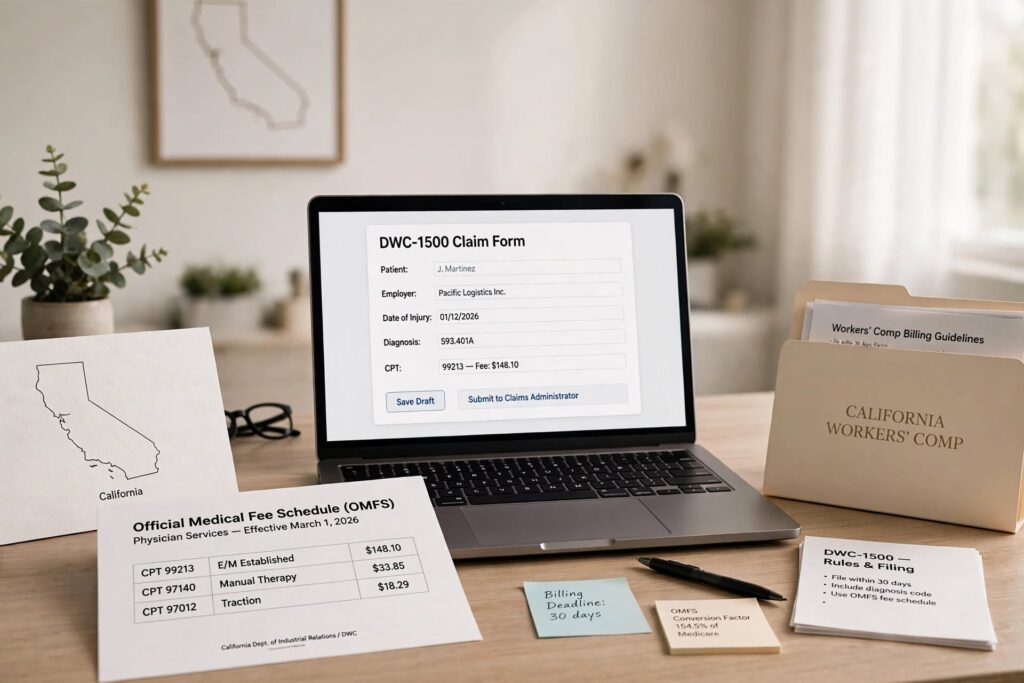
The medical billing services California practices rely on for workers compensation work operate under a system that shares almost nothing with group health billing. Different fee schedules, different forms requirements, different payment deadlines, and a dispute process with steps that have to be taken in order.
Practices that treat a workers compensation claim like a commercial claim with a different payer generally discover the difference through underpayments they never appeal and denials they cannot fix after the fact.
The Fee Schedule Is Built on Medicare & Adjusted Repeatedly
The Official Medical Fee Schedule sets reimbursement for treating work-related injuries. The physician portion is built on resource-based relative value methodology, with geographic adjustment and conversion factors applied on top, and it tracks Medicare closely enough that Medicare changes flow through to it.
That tracking has a consequence practices feel every January. When Medicare deletes codes, those codes stop being payable under the state schedule as well, and billing them after the update takes effect produces denials. New codes get added on the same cycle.
The schedule is also updated within the year through administrative director orders, not only at the start of it. A practice checking the fee schedule once a year is working from figures that have already moved.
Verify the Payment Rather Than Assuming It
Fee schedule calculation involves enough moving parts that miscalculation is common, and it usually runs in the direction of underpayment. The explanation of review shows how the payer processed the bill, and comparing it against your own calculation is what surfaces the gap.
Practices that do not check simply absorb the difference. There is no denial to work and no rejection to notice, which is exactly why this loss persists in practices that otherwise manage their receivables well.
A Note on What the DWC-1500 Actually Is
People working in California workers compensation often speak of the DWC-1500 when they mean the professional billing form used in the system. The form itself is the standard CMS-1500, version 02-12, completed according to the requirements the Division of Workers Compensation sets out. There is no separately printed state version of the professional claim form.
The document that carries a state form designation is the employee claim form used to open a claim, which the injured worker files rather than the treating provider. Institutional providers use the standard institutional form, dental uses the dental claim form, and pharmacy uses the pharmacy claim form.
The distinction matters when ordering forms or configuring a billing system, because searching for a state-specific professional form produces nothing. What differs in California is not the form but the completion requirements attached to it.
Fields have to be populated according to the state billing guide, and the guide specifies requirements that go beyond standard commercial completion.
What Makes a Bill Complete
The state defines completeness, and an incomplete bill does not start the payment clock. A bill that arrives missing a required element sits without the protections a complete bill carries.
Completeness requires the correct form or the correct electronic format, correct coding for the applicable fee schedule including the diagnosis coding, fields populated according to the requirements for that format, and the required reports and supporting documentation attached.
Required Reports Are Part of the Bill
This is where the system departs most sharply from group health. Certain reports are required rather than optional, including the initial report of injury and the progress and permanent status reports that follow. Reports accompanying by-report code billing are also required.
Supporting documentation covers what is needed to substantiate the bill, including invoices for equipment items and any written authorization received for the services. A bill submitted without the documentation that supports it is incomplete even when the coding is correct.
Practices that submit clean claims and hold documentation until asked are creating incomplete bills by definition, and the delay compounds because the clock does not run.
Payment Timing Favors Electronic Submission
For bills submitted electronically at or below the maximum allowed under the fee schedule, payment is due within fifteen working days of receipt. That deadline is set in statute.
Paper submission does not carry the same timing, which makes electronic billing worth the setup effort on volume alone. Electronic submission also produces a transmission record, which matters when a payer disputes receipt.
Payers are required to return an electronic explanation of review meeting state requirements for electronically submitted bills, so the documentation supporting a dispute arrives in a usable form.
The Dispute Process Has an Order
Underpayment disputes follow a sequence, and skipping a step forfeits the later ones.
Second bill review comes first, filed with the payer within the required window after the explanation of review. This is the step practices most often miss, and missing it closes the path to everything after it.
Independent bill review follows if a second review does not resolve the amount. It is the mechanism for disputes about how much the fee schedule requires, and it is available only after the second review has been completed.
Disputes about liability rather than amount follow a different track through the state system, which is a separate process from bill review and should not be confused with it.
The practical rule is to treat every explanation of review as requiring a decision within the second review window rather than filing it and moving on. Once that window closes, the underpayment is permanent regardless of how clearly the fee schedule supported a higher amount.
Filing Deadlines
Bills are generally submitted within twelve months of the date of service. Earlier submission is better than the deadline suggests, since disputes take time and a bill submitted near the limit leaves no room for the review sequence.
Where Practices Lose Money
The losses cluster in predictable places. Underpayments absorbed because nobody compared the explanation of review to the fee schedule. Second bill review windows missed, which forfeits independent review. Bills submitted without required reports, leaving them incomplete and outside the payment timeline. Deleted codes billed after a fee schedule update. Paper submission where electronic would have carried a statutory payment deadline.
Every one of these is procedural rather than clinical. The treatment was appropriate and the coding was often correct.
Build the fee schedule check into payment posting rather than leaving it as an occasional audit, track second review deadlines the way you track filing deadlines, and confirm required reports are attached before submission rather than after a payer asks.
If workers compensation payments are coming in below what the fee schedule supports and the disputes are not getting filed in time, our team can review where the process is breaking down.