
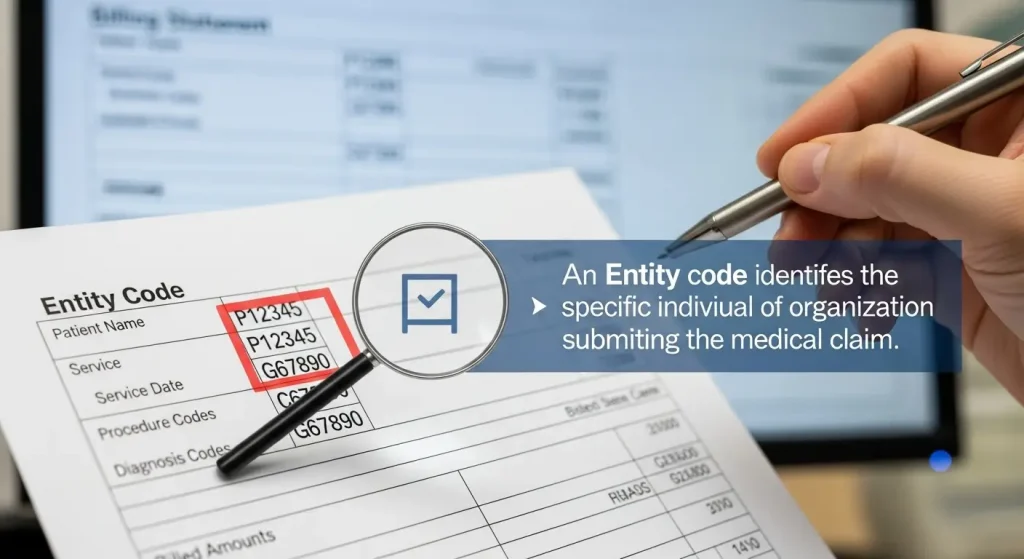
If you’ve ever submitted what seemed like a perfectly clean claim correct CPT codes, accurate patient details, everything polished only to have it bounce back with the rejection saying “This code requires use of an entity code,” you’re not alone. What Is an Entity Code in Medical Billing? It’s one of the most common and confusing questions billers face, and these entity-code-related denials continue to frustrate even experienced professionals.
For many providers, billers, and coders, the phrase entity code sounds vague, overly technical, or downright mysterious. Yet these codes play a crucial role in ensuring claims get processed correctly. Missing or incorrect entity codes can lead to delays, claim rejections, and unnecessary back-and-forth with payers.
This guide breaks everything down in plain English. By the end, you’ll understand:
-
What an entity code actually is
-
Why entity codes matter
-
How they prevent common claim errors
-
What causes entity-code-related denials
-
How to use them correctly in your workflow
Let’s dive in.
Understanding Entity Codes in Medical Billing
What Is an Entity Code in Medical Billing?
At its core, an entity code is an alphanumeric identifier used in medical billing to indicate who is involved in a healthcare transaction and what role they play.
Think of entity codes as digital labels or fingerprints inside the claim. When a claim is submitted electronically, clearinghouses and insurers must know:
-
Who the patient is
-
Who the subscriber is
-
Whether the patient is a dependent
-
Who rendered the service
-
Who’s billing for the service
-
Who the payer is
-
Where the service occurred
Each of these participants is an entity, and each must be labeled correctly to avoid confusion. Entity codes make that possible.
Without proper entity codes, the system can’t determine basic relationships like:
-
Is the patient also the policyholder?
-
Did a referring provider send the patient?
-
Did the billing provider differ from the rendering provider?
-
Which insurance company is responsible for payment?
Entity codes bring order and clarity to an otherwise complex exchange of data.
Why Entity Codes Exist
Medical billing involves dozens of moving parts and dozens of systems speaking to one another. Entity codes exist to create standardization across all of them.
They serve four major purposes:
1. Standardization Across Insurance Companies
Every payer processes data differently, but entity codes create a universal language so claims can be interpreted consistently.
2. Eliminate Confusion
By labeling each individual or group involved in the claim, entity codes ensure that relationships are clear.
3. EDI Efficiency
Electronic Data Interchange (EDI) relies heavily on standardized identifiers. Entity codes help claims move through clearinghouses and payer systems without misrouting.
4. Compliance & Accuracy
Using the correct entity code supports HIPAA compliance and reduces administrative errors that could trigger audits or denials.
Examples of Key Entities in Healthcare Claims
To understand entity codes, it helps to understand the entities themselves. The most common ones include:
• Subscriber
The person who holds the insurance policy.
• Dependent
Someone covered under the subscriber (child, spouse, etc.).
• Rendering Provider
The clinician who actually delivered the service.
• Billing Provider
The individual or organization responsible for submitting the claim.
• Referring Provider
A provider who sent the patient for the service.
• Payer
The insurance company or government program responsible for payment.
• Service Facility Location
Where the service took place (hospital, office, clinic, lab).
Each of these needs to be properly identified in order for a claim to be processed smoothly.
Types of Entity Codes Used in Medical Billing
Entity codes are used to differentiate the types of participants in a claim. Here’s how each type works.
Subscriber Codes
Subscriber codes clarify that the claim is tied to the primary policyholder. These codes make sure the payer associates the right individual with the insurance plan.
For example:
-
If the subscriber is also the patient, one code is required.
-
If the subscriber is different from the patient, another code is applied.
Correct subscriber coding eliminates misunderstandings about coverage eligibility.
Dependent Codes
Dependent codes indicate that the patient is covered under the subscriber’s plan. These are commonly used in cases involving:
-
Children
-
Spouses
-
Elderly parents
-
Students
Incorrect dependent codes often lead to denials stating that coverage cannot be found or the relationship code is inaccurate.
Provider Codes
Provider codes are used to identify roles such as:
-
Rendering provider
-
Billing provider
-
Ordering provider
-
Supervising provider
For example, a radiology claim may involve:
-
A referring provider
-
An interpreting provider
-
A billing provider
Each must be labeled properly to avoid payer confusion or mismatched NPI errors.
Payer Codes
These codes identify the entity paying the claim:
-
Commercial insurers
-
Medicare
-
Medicaid
-
Workers’ compensation
-
Managed care organizations
Even a small discrepancy can send the claim to the wrong payer, resulting in unnecessary delays.
Service Location Codes
Entity codes also apply to where the service was performed:
-
Hospital
-
Urgent care
-
Outpatient clinic
-
Practitioner’s office
-
Skilled nursing facility
Location matters because payers reimburse differently depending on the setting.
How Entity Codes Work in the Claims Process
Understanding how entity codes flow through the claim lifecycle will help you catch errors before they cause rejections.
Step-by-Step Workflow
1. Claim Creation
The biller enters patient, provider, and payer details.
2. Entity Identification
The system determines which roles are involved and applies the appropriate codes.
3. EDI Validation
The electronic claim file undergoes structural checks.
4. Clearinghouse Review
Clearinghouses detect missing or invalid entity codes early.
5. Payer Processing
Claims are accepted or rejected based on matching information to the payer’s database.
Role of Entity Codes in Error Prevention
Entity codes help ensure:
-
The claim is assigned to the correct payer
-
The right individual is billed
-
The provider is valid and credentialed
-
The subscriber–dependent relationship is accurate
They prevent claims from being misrouted or misinterpreted, dramatically reducing the risk of avoidable denials.
Where Entity Codes Appear on Forms
Entity codes aren’t always obvious, but they play a role in:
• CMS-1500 Claims
Used by non-institutional providers.
• UB-04 Claims
Used by hospitals and facilities.
• EDI 837 Formats
Electronic claims where entity codes are embedded in loops and segments (e.g., Loop 2010BA for subscribers).
Common Entity Code Errors and How to Avoid Them
Let’s look at the errors that appear most often and how to resolve them quickly.
This Code Requires Use of an Entity Code
This rejection appears when:
-
The system expects an additional entity but doesn’t find it
-
A dependent is listed without a subscriber
-
A rendering provider is missing
-
A referring provider field is required but empty
Fix: Determine which entity is missing or incomplete and update the claim accordingly.
Entity Not Found
This error typically indicates:
-
Incorrect NPI
-
Provider taxonomy mismatch
-
Dependents not linked correctly
-
Invalid payer ID
Fix: Verify NPIs, addresses, relationship codes, and payer data.
Other Reasons Claims Get Rejected
-
Wrong subscriber relationship codes
-
Missing payer entity
-
Incorrect provider roles
-
Mismatched subscriber and dependent details
-
Outdated provider information on file
How to Fix Entity-Code Errors Quickly
-
Verify all NPIs
-
Check subscriber/dependent relationships
-
Confirm payer IDs
-
Ensure rendering and billing provider roles are assigned correctly
-
Review clearinghouse error descriptions
-
Compare claim data with payer enrollment files
Small mistakes in these areas can derail even the most accurate claims.
Why Entity Codes Matter for Revenue Cycle Management
Entity codes have a much bigger impact on revenue than most practices realize.
Faster Claim Processing
When entity codes are correct, payers process claims without confusion or rerouting, resulting in quicker payments.
Better Compliance
Accurate entity coding supports HIPAA-mandated electronic transaction standards. This reduces audit risk and ensures proper documentation.
Higher Reimbursement Rates
Fewer errors → fewer denials → stronger cash flow.
Mistakes involving missing or invalid entity codes can delay payment by weeks, sometimes months.
More Accurate Healthcare Data
Clean, consistent data helps practices:
-
Track performance
-
Reduce errors
-
Improve reporting accuracy
-
Make informed financial decisions
Tips for Using Entity Codes Correctly
Verify Subscriber and Dependent Relationships
Always confirm:
-
Who the policyholder is
-
How the patient is related to them
-
Whether the dependent is eligible
Incorrect relationship codes are a top cause of denials.
Maintain Updated Provider Information
Ensure every system reflects the current:
-
NPI
-
Taxonomy
-
TIN
-
Address
-
Credentials
Provider mismatches cause countless rejected claims.
Double-Check Payer Requirements
Some insurers have unique entity-coding rules. When in doubt, check:
-
The payer’s billing manual
-
Clearinghouse notes
-
Provider enrollment details
Train Billing Staff Regularly
Because entity-related errors are so common, consistent training can dramatically improve clean-claim rates.
Frequently Asked Questions
What is an example of an entity code in medical billing?
A common example is the code used to show whether the patient is the subscriber or a dependent.
What does “this code requires the use of an entity code” mean?
It means a required party (like a provider, subscriber, or payer) is missing or incorrectly identified on the claim.
Where can I find the entity code on a claim form?
On paper forms, the fields relate to entity roles. In electronic claims, entity codes appear in EDI loops and segments.
What is an entity code rejection?
This occurs when a payer refuses a claim due to missing, invalid, or mismatched entity information.
Is an entity code the same as an NPI?
No. An NPI identifies a provider, while an entity code identifies their role in the claim.
Conclusion: Why Understanding Entity Codes Improves Clean Claims
Entity codes may seem technical, but their purpose is simple: they ensure that every claim correctly communicates who did what, who received the service, and who is responsible for payment.
When entity codes are used properly:
-
Claims get processed faster
-
Denials drop dramatically
-
Data stays organized
-
Revenue cycles become more efficient
Before you submit your next claim, take a moment to confirm that every entity is clearly identified. A few seconds of verification can mean the difference between fast reimbursement and unnecessary delays.