
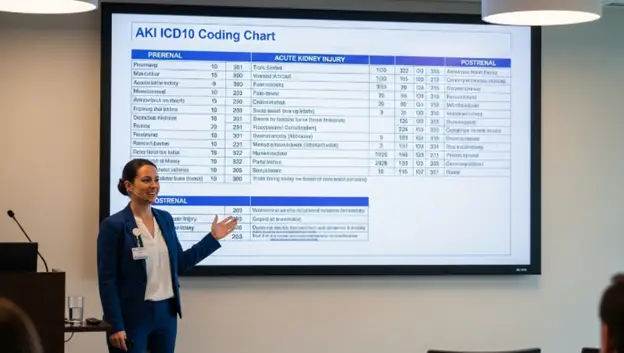
Acute Kidney Injury (AKI) is a sudden and often reversible loss of kidney function that can affect patients of all ages. Correct coding of AKI using ICD-10 is critical for accurate medical documentation, billing, and clinical decision-making. This guide provides a comprehensive overview of AKI ICD10, including code classifications, coding tips, step-by-step instructions, and frequently asked questions.
Short Answer – AKI ICD10
AKI is coded in ICD-10 under the N17 series, which includes:
| ICD-10 Code | Description |
| N17.0 | Acute kidney failure with tubular necrosis |
| N17.1 | Acute kidney failure with cortical necrosis |
| N17.2 | Acute kidney failure with medullary necrosis |
| N17.8 | Other specified acute kidney failure |
| N17.9 | Acute kidney failure, unspecified |
When to use N17.0–N17.9:
- 0–N17.2: Use when the underlying type of AKI is confirmed (tubular, cortical, or medullary necrosis)
- 8: For less common or unspecified AKI types
- 9: Use when the type of AKI is unknown
All codes are billable, but proper documentation is required to ensure compliance with CMS and payer guidelines.
Understanding AKI ICD10 – Complete Guide
What is AKI (Acute Kidney Injury) ICD10?
AKI is a clinical syndrome characterized by rapid loss of kidney function, usually measured by an abrupt rise in serum creatinine or decreased urine output. Key points include:
- Clinical significance: AKI can lead to electrolyte imbalances, fluid overload, and life-threatening complications.
- Diagnostic criteria: Increase in serum creatinine by ≥0.3 mg/dL within 48 hours, or ≥50% increase from baseline, or urine output <0.5 mL/kg/hr for 6 hours.
- AKI vs CKD: Unlike chronic kidney disease (CKD), AKI is sudden and often reversible; CKD represents long-term kidney damage.
Why Correct AKI ICD10 Coding is Important
Proper coding ensures:
- Accurate reimbursement for services rendered
- Compliance with CMS and insurance requirements
- Reduced claim denial risk
- Clear medical records for continuity of care
AKI ICD10 Based on Type and Cause
- Pre-renal AKI ICD10 codes: Caused by decreased renal perfusion (e.g., hypovolemia, heart failure)
- Intrinsic renal AKI ICD10 codes: Due to damage within the kidney (e.g., ATN, cortical necrosis)
- Post-renal AKI ICD10 codes: Caused by obstruction of urinary flow (e.g., stones, tumors)
AKI ICD10 Codes by Classification
N17.0 – Acute Kidney Failure with Tubular Necrosis
- Most common form of AKI
- Often results from ischemia or nephrotoxins
- Billable for reimbursement purposes
N17.1 – Acute Kidney Failure with Acute Cortical Necrosis
- Rare, severe AKI type
- Frequently post-infection or postpartum
- Requires detailed clinical documentation
N17.2 – Acute Kidney Failure with Medullary Necrosis
- Often associated with infection or sickle cell disease
- Must confirm via lab and imaging
N17.8 – Other Specified Acute Kidney Failure
- Covers miscellaneous or rare causes not captured by N17.0–N17.2
N17.9 – Acute Kidney Failure, Unspecified
- Use when type or cause of AKI is unknown
AKI ICD10 Comparison Table
| ICD-10 Code | Description | Billable | Clinical Notes | Common Synonyms |
| N17.0 | Acute kidney failure with tubular necrosis | Yes | Most common type | Acute tubular necrosis, ATN |
| N17.1 | Acute kidney failure with cortical necrosis | Yes | Rare, severe | Acute cortical necrosis |
| N17.2 | Acute kidney failure with medullary necrosis | Yes | Often post-infection | Medullary necrosis |
| N17.8 | Other specified acute kidney failure | Yes | Miscellaneous causes | AKI other specified |
| N17.9 | Acute kidney failure, unspecified | Yes | Default when type unknown | AKI unspecified |
Step-by-Step Guide to Coding AKI ICD10
Step 1 – Identify the Type of AKI
- Determine pre-renal, intrinsic, or post-renal
- Review lab results: serum creatinine, BUN, urine output
Step 2 – Verify Clinical Documentation
- Confirm onset, cause, severity
- Check for associated conditions (e.g., sepsis, obstruction)
Step 3 – Select the Correct ICD-10 Code
- Map the clinical diagnosis to ICD-10 codes (N17.0–N17.9)
Step 4 – Consider Additional Coding
- Use additional codes for underlying conditions (e.g., B33.4 for viral infections)
Step 5 – Check Billable vs Non-Billable Codes
- Ensure only billable codes are used for reimbursement
Step 6 – Apply Modifiers if Needed
- When AKI is secondary to procedures or trauma
AKI ICD10 vs Chronic Kidney Disease Codes
| Condition | ICD-10 Range | Key Notes |
| AKI | N17.0–N17.9 | Sudden onset, often reversible |
| CKD | N18.1–N18.9 | Chronic, progressive kidney damage |
| Acute-on-chronic | N17.0–N17.9 + N18.x | Use both codes to capture acute worsening |
AKI ICD10 vs Chronic Kidney Disease Codes
| Condition | ICD-10 Range | Key Notes |
| AKI | N17.0–N17.9 | Sudden onset, often reversible |
| CKD | N18.1–N18.9 | Chronic, progressive kidney damage |
| Acute-on-chronic | N17.0–N17.9 + N18.x | Use both codes to capture acute worsening |
People Also Ask – AKI ICD10
What is the ICD-10 code for acute kidney injury?
- Typically 0–N17.9, depending on type
What is the difference between N17.0 and N17.9?
- 0: Tubular necrosis, specific cause
- 9: Unspecified AKI, unknown cause
Can AKI and CKD be coded together?
- Yes, especially for acute-on-chronic cases
Is N17.9 billable?
- Yes, but only when type is unknown
What additional codes should be used with AKI ICD10?
- Codes for sepsis, nephrotoxins, infections
How to code AKI due to contrast agents?
- Use N17.0 or N17.8 depending on documentation
- Add T codes for contrast-induced injury if required
Does Medicare cover AKI treatment based on ICD10 coding?
- Yes, provided accurate coding and documentation are submitted
What is the clinical significance of each AKI ICD10 code?
- Helps guide treatment, prognosis, and reimbursement
FAQs – AKI ICD10
- What is the main ICD10 code for AKI?
N17.9 is used when unspecified; N17.0–N17.8 for specific types - How do you code AKI based on etiology?
Match lab, imaging, and clinical notes to N17 subcodes - Can unspecified AKI (N17.9) be used for all cases?
Only when the cause or type is not documented - What ICD10 code is used for post-renal AKI?
N17.8 if obstruction is confirmed - Are there add-on codes for AKI with sepsis?
Yes, additional infection or sepsis codes may be required - How do labs support AKI ICD10 coding?
Lab trends confirm severity, onset, and type - What documentation is required for accurate AKI coding?
Include onset, type, severity, underlying causes, and labs - Can multiple AKI types be coded simultaneously?
Yes, if patient has more than one documented AKI type - How often are ICD10 codes for AKI updated?
Reviewed annually; N17 series has remained stable recently
Conclusion – AKI ICD10
Accurate coding of AKI ICD10 is critical for billing, compliance, and patient care. The key codes are N17.0–N17.9, with proper selection based on clinical documentation. By following step-by-step guidance and using tables and cheat sheets, clinicians and coders can ensure accuracy, reimbursement, and quality care.