
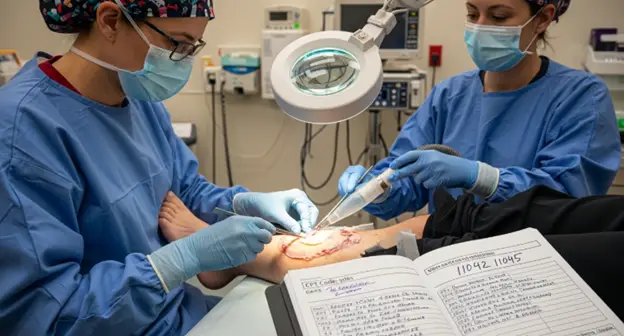
Wound debridement is one of the most commonly coded procedures in wound care, outpatient clinics, and hospital settings. However, selecting the correct CPT code depends on tissue depth, wound size, documentation, and procedure type, which makes coding confusing for many medical billers and coders. This guide provides a complete, step-by-step explanation of CPT codes for wound debridement, including coding rules, documentation requirements, examples, and billing guidelines.
Short Answer – CPT Codes for Wound Debridement
The primary CPT codes for wound debridement are based on the depth of tissue removed and surface area of the wound.
Primary CPT codes used for wound debridement
- 97597 – Debridement of skin (first 20 sq cm)
- 97598 – Each additional 20 sq cm (add-on)
- 11042 – Subcutaneous tissue (first 20 sq cm)
- 11045 – Each additional 20 sq cm
- 11043 – Muscle and fascia (first 20 sq cm)
- 11046 – Each additional 20 sq cm
- 11044 – Bone debridement (first 20 sq cm)
- 11047 – Each additional 20 sq cm
Quick depth-based coding explanation
| Tissue Depth | CPT Code |
| Skin only | 97597 |
| Subcutaneous tissue | 11042 |
| Muscle/Fascia | 11043 |
| Bone | 11044 |
Understanding CPT Codes for Wound Debridement (Complete Guide)
What Are CPT Codes for Wound Debridement?
CPT codes for wound debridement are medical billing codes used to report the removal of dead, infected, or contaminated tissue from a wound to promote healing. These codes are selected based on:
- Depth of tissue removed
- Size of wound surface area
- Number of wounds treated
- Type of debridement (selective vs non-selective)
Why Correct Wound Debridement Coding Is Important
Incorrect coding can lead to:
- Claim denials
- Underpayment
- Overbilling audits
- Compliance issues
- Insurance rejections
Proper coding ensures accurate reimbursement and compliance with billing regulations.
Documentation Requirements for Wound Debridement Coding
Documentation must include:
- Wound location
- Tissue depth removed
- Surface area in sq cm
- Instruments used
- Type of tissue removed
- Medical necessity
- Before and after wound measurements
CPT Codes for Wound Debridement Based on Depth
The most important rule in wound debridement coding is:
Code based on the deepest tissue removed, not the wound depth.
For example, if bone, muscle, and skin are removed, you code bone debridement (11044).
CPT Codes for Wound Debridement by Depth and Tissue Type
Debridement of Skin (Epidermis/Dermis) – CPT Codes
Used when only skin tissue is removed.
- 97597 – First 20 sq cm
- 97598 – Each additional 20 sq cm
These are considered selective debridement codes.
Debridement of Subcutaneous Tissue – CPT Codes
Used when tissue removal reaches subcutaneous layer.
- 11042 – First 20 sq cm
- 11045 – Each additional 20 sq cm
These are non-selective excisional debridement codes.
Debridement of Muscle and Fascia – CPT Codes
Used when removal includes muscle or fascia.
- 11043 – First 20 sq cm
- 11046 – Each additional 20 sq cm
Debridement of Bone – CPT Codes
Used for deepest wound debridement involving bone.
- 11044 – First 20 sq cm
- 11047 – Each additional 20 sq cm
Wound Debridement CPT Codes Comparison Table
| CPT Code | Tissue Depth | Wound Size | Add-on Code | Description |
| 97597 | Skin | First 20 cm | 97598 | Selective debridement |
| 11042 | Subcutaneous | First 20 cm | 11045 | Non-selective |
| 11043 | Muscle | First 20 cm | 11046 | Deep tissue |
| 11044 | Bone | First 20 cm | 11047 | Bone debridement |
Guide to Coding Wound Debridement CPT Codes
Step 1 – Determine the Depth of Tissue Removed
Identify the deepest level of tissue removed:
- Skin
- Subcutaneous
- Muscle
- Bone
Step 2 – Measure Wound Surface Area
Measure wound length × width = total sq cm.
Step 3 – Select the Correct Primary CPT Code
Choose the code based on deepest tissue removed.
Step 4 – Add Add-On Codes for Larger Wounds
If wound size exceeds 20 sq cm:
- Add 11045, 11046, or 11047 accordingly.
Step 5 – Check Documentation Requirements
Ensure documentation includes:
- Depth
- Size
- Tissue removed
- Medical necessity
Step 6 – Verify ICD-10 Diagnosis Code
Common ICD-10 codes include:
- Pressure ulcers
- Diabetic ulcers
- Open wounds
- Infection
Step 7 – Apply Modifiers if Required
Common modifiers:
- 59 – Distinct procedural service
- 25 – E/M same day
- 76 – Repeat procedure
Difference Between Common Wound Debridement CPT Codes
Difference Between 11042 and 11043
| Code | Tissue |
| 11042 | Subcutaneous |
| 11043 | Muscle/Fascia |
Difference Between 97597 and 11042
| Code | Type |
| 97597 | Selective skin debridement |
| 11042 | Excisional subcutaneous debridement |
Difference Between 97140 and 97110
These are therapy codes, not debridement codes:
- 97140 – Manual therapy
- 97110 – Therapeutic exercise
When to Use Add-On Codes 11045, 11046, 11047
Use add-on codes when wound size exceeds 20 sq cm.
CPT Codes for Wound Care Without Debridement
Wound Dressing Change CPT Codes
Often included in E/M services and not separately billable.
Wound Irrigation CPT Codes
Sometimes billed under 97597 if debridement performed.
Wound Exploration CPT Codes
May use surgical exploration codes depending on procedure.
Wound Washout Under Anesthesia CPT Codes
Often coded using surgical debridement codes.
Wound Closure CPT Codes
Use 12001–13160 depending on complexity.
Wound Debridement With Skin Graft CPT Codes
Use graft codes along with debridement if performed separately.
Documentation Requirements for Wound Debridement CPT Codes
Required Elements in Operative Note
- Wound location
- Measurements
- Depth
- Tissue removed
- Instruments used
- Bleeding control
- Dressing applied
Depth Documentation
Must clearly state:
- Skin
- Subcutaneous
- Muscle
- Bone
Surface Area Documentation
Total wound size in sq cm must be documented.
Tissue Removed Documentation
Examples:
- Necrotic tissue
- Slough
- Eschar
- Infected tissue
Instruments Used Documentation
Examples:
- Scalpel
- Curette
- Scissors
- Forceps
Medical Necessity Documentation
Must state reason:
- Infection
- Necrosis
- Non-healing wound
Billing Guidelines and Coding Rules for Wound Debridement
CPT Coding Guidelines
Always code based on:
- Deepest tissue removed
- Total wound size
- Procedure type
Medicare Billing Rules
Medicare requires:
- Detailed documentation
- Medical necessity
- Accurate measurements
- Correct modifiers
NCCI Edits and Bundling Rules
Some services are bundled with debridement and cannot be billed separately.
Multiple Wounds Coding Rules
Add total wound surface area together if same depth.
Modifier Usage (59, 25, 76, etc.)
Modifiers help avoid claim denials.
Global Period Considerations
Some surgical debridement codes have global periods.
Common Coding Mistakes for Wound Debridement CPT Codes
- Using wrong depth code
- Not calculating total wound size
- Billing selective vs non-selective incorrectly
- Missing add-on codes
- Documentation errors
- Modifier misuse
CPT Codes for Wound Debridement – Real Coding Examples
Example 1 – Subcutaneous Debridement
Wound 5 × 4 cm → 20 sq cm → 11042
Example 2 – Muscle Debridement
Wound 6 × 5 cm → 30 sq cm → 11043 + 11046
Example 3 – Bone Debridement
Wound involving bone → 11044
Example 4 – Multiple Wounds Debridement
Two wounds same depth → Combine total area → Select code.
Example 5 – Debridement With Closure
Debridement may be included in closure depending on procedure.
Example 6 – Debridement With Skin Graft
Debridement coded separately if medically necessary.
People Also Ask – CPT Codes for Wound Debridement
What is the CPT code for wound debridement?
Common codes include 97597, 11042, 11043, and 11044 depending on tissue depth.
What is the difference between 11042 and 11043?
11042 is for subcutaneous tissue, while 11043 is for muscle/fascia.
What is the difference between 97140 and 97110?
These are therapy codes, not wound debridement codes.
What is CPT code 11042 for wound debridement?
It is used for subcutaneous tissue debridement (first 20 sq cm).
When should CPT code 97597 be used?
When only skin tissue is removed.
How do you bill multiple wound debridements?
Combine total wound area if same depth; code deepest wound separately.
What modifier is used for wound debridement?
Common modifiers include 59, 25, and 76.
Is wound debridement covered by Medicare?
Yes, if medically necessary and properly documented.
FAQs – CPT Codes for Wound Debridement
What are the main CPT codes for wound debridement?
97597, 11042, 11043, and 11044 are the main codes.
How do you code wound debridement based on depth?
Always code based on the deepest tissue removed.
What is the CPT code for wound care without debridement?
Usually included in evaluation and management services.
Can multiple wounds be billed separately?
Yes, depending on depth and location.
What is the add-on code for 11042?
11045 is the add-on code.
What documentation is required for debridement coding?
Depth, size, tissue removed, and medical necessity.
What is selective vs non-selective debridement?
Selective removes specific tissue; non-selective removes all necrotic tissue.
Can debridement and closure be billed together?
Sometimes, depending on procedure type.
What ICD-10 codes are used with wound debridement?
Pressure ulcers, diabetic ulcers, open wounds, infections.
How does Medicare reimburse wound debridement?
Based on CPT code, documentation, and medical necessity.
Conclusion – CPT Codes for Wound Debridement
Understanding CPT codes for wound debridement is essential for accurate medical billing, compliance, and proper reimbursement. The most important rule is to code based on the deepest tissue removed and total wound surface area. Proper documentation, correct modifier usage, and understanding add-on codes are critical to avoid claim denials and audits. Organizations like AAAMB provide guidelines and resources to help medical coders and billers stay compliant and up-to-date with best practices.
Final Quick Reference:
| Tissue Depth | CPT Code |
| Skin | 97597 |
| Subcutaneous | 11042 |
| Muscle | 11043 |
| Bone | 11044 |
Accurate coding ensures proper reimbursement, compliance with Medicare guidelines, and smooth claim processing.
ICD-10 Codes Commonly Used With Wound Debridement
- Pressure ulcer codes
- Diabetic ulcer codes
- Open wound codes
- Infection codes
- Surgical wound codes
Wound Debridement Coding Cheat Sheet
- Determine deepest tissue
- Measure wound size
- Choose CPT code
- Add add-on codes
- Check documentation
- Apply modifiers
- Verify ICD-10 code
CPT Codes for Pressure Ulcer Debridement
Usually coded using:
- 97597
- 11042
- 11043
- 11044
CPT Codes for Diabetic Foot Ulcer Debridement
Often coded using 11042 or 11043 depending on tissue depth.
CPT Codes for Surgical Debridement vs Non-Surgical Debridement
| Type | Codes |
| Non-surgical | 97597 |
| Surgical | 11042–11047 |
Global Period and Modifier Guidelines for Debridement
Modifiers:
- 25
- 59
- 76
- 58
Medicare Reimbursement Rates for Wound Debridement CPT Codes
Reimbursement varies by:
- Facility vs non-facility
- Geographic location
- Medicare fee schedule
- Documentation quality